

Carrot, Walnut & Cranberry Sourdough
Autumn in bread form

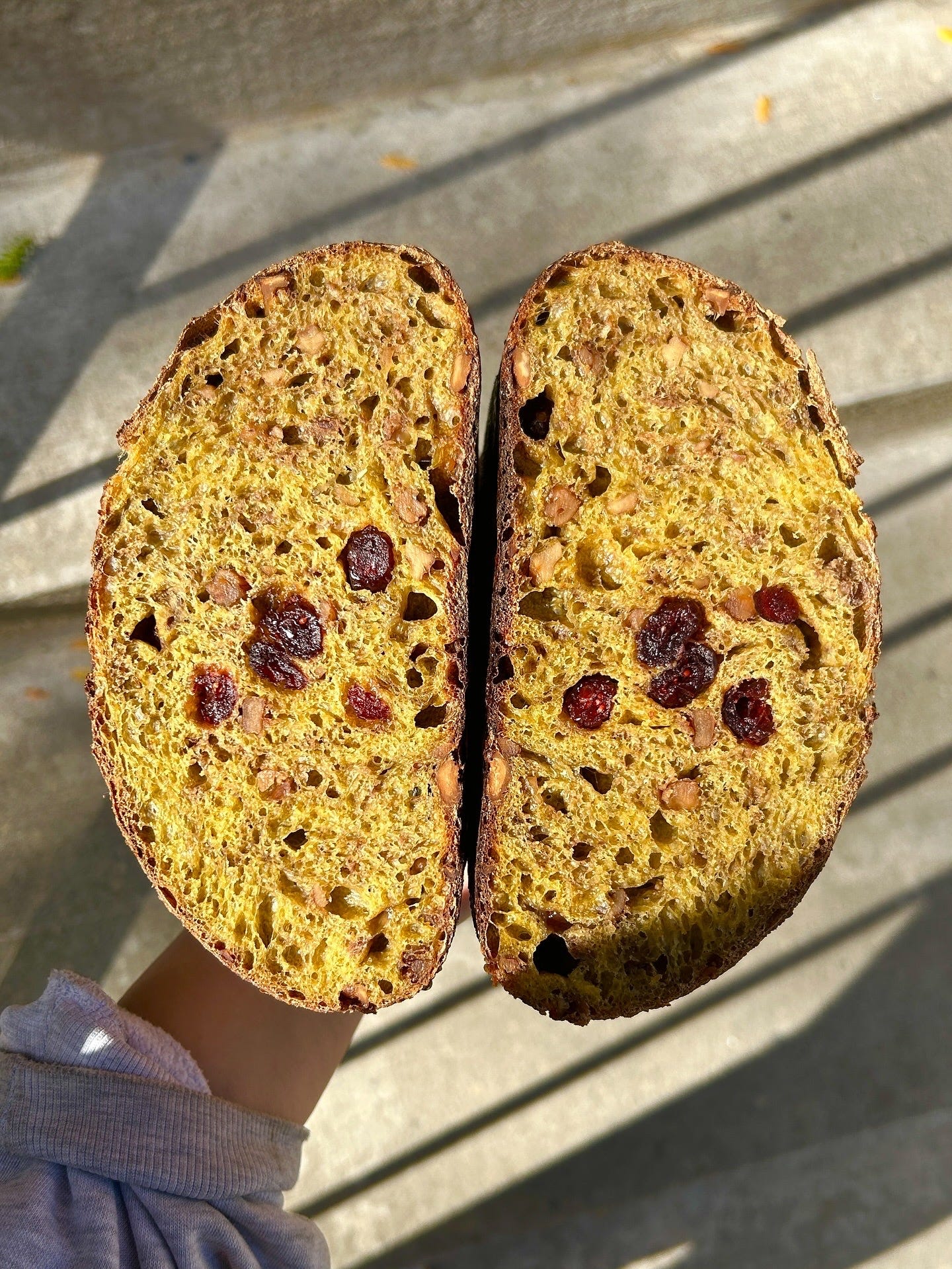


I wanted to make a sourdough that really captured everything I love about fall, the flavours, the smell, and of course, the colour. Something bright and cozy at the same time. Carrot juice felt like the perfect way to do that, it’s naturally sweet, earthy, and gives the dough the most beautiful golden-orange hue. I thought it might make the bread too sweet, but it actually turned out super balanced, with this gentle, earthy flavour that feels just right.
This loaf is packed with toasted walnuts and tart cranberries, it’s definitely a hearty one. There’s quite a bit of inclusions in here, and that’s intentional, but you can absolutely scale them down if you prefer something a bit lighter. I don’t soak the walnuts or cranberries since the dough is already pretty high in hydration. If you want to play around, this base dough would also be delicious with a little spice, think cinnamon, ginger, or even a touch of cardamom would fit right in.
Ingredients
200 g bread flour (50%)
200 g all-purpose flour (50%)
300 g fresh pressed carrot juice (75%)
250 g for the autolyse
50 g reserved to add with the salt
80 g active starter (20%)
10 g fine sea salt (2.5%)
80 g toasted walnuts, chopped (20%)
80 g dried cranberries (20%)
** Goal dough temperature: 78°F / 25.5°C
To achieve this, adjust the temperature of your carrot juice. In warm weather, use cooler juice and in cooler environments, slightly warmer. To figure this out I like using this calculator.
1. Autolyse
In a large mixing bowl, combine 250 g of carrot juice (adjusted so your final dough temp will reach ~78°F / 25.5°C) with 80 g of active starter.
Mix gently with your hand or a Danish dough whisk until the starter dissolves.Add both flours (200 g bread + 200 g all-purpose) and mix until no dry flour remains. The dough should be shaggy and slightly sticky.
Cover and rest for 1 hour.
**Autolyse allows the flour to hydrate, promoting gluten development and extensibility without kneading.
2. Add Salt and Remaining Juice
Sprinkle 10 g salt over the dough.
Add the remaining 50 g carrot juice.
You can use your hands, but I like to use a stand mixer for this step. This dough can be quite shaggy, and it benefits from building a good amount of gluten up front. Mix on low speed (or by hand, pinching and squeezing the dough between your fingers) until the salt and remaining carrot juice are fully incorporated and the dough begins to feel stronger and more cohesive. I like to take it right up to the point just before it would pass the windowpane test. This can take 7-10 minutes. In the last minute of mixing, gently fold in the walnuts and cranberries, since this is a high amount of mix-ins and adding them too early can tear the gluten structure.
Once mixed, cover and let rest for 45 minutes before your first set of folds.
**After mixing, the dough should feel smooth and elastic, with a target temperature of about 78°F (25.5°C).


3. Bulk Fermentation
(3–5 hours total at 78°F / 25.5°C)
For the first 1.5 hours, perform 2 gentle stretch and folds at 45-minute intervals:
With damp hands, lift one side of the dough and fold it over itself.
Rotate the bowl 90° and repeat until all four sides have been folded (one full turn).
Because we’ve already built a lot of gluten during mixing, you can be gentle with these folds. If it’s a busy day, even just one well-executed stretch and fold will give excellent results.
Sourdough bulk fermentation is complete when the dough has visibly increased in volume (typically 40–50% or roughly doubled), feels airy, elastic, and slightly jiggly, and shows bubbles along the surface and sides. The dough should pull away from the bowl when tilted, feel more cohesive and less sticky.
**If your dough temperature falls below 76°F (24°C), fermentation will slow. If it exceeds 80°F (26.5°C), reduce the proofing time slightly.
4. First Shaping
Turn the dough out onto a lightly floured surface.
Using a bench scraper, fold it in half with the floured side on the outside.
Shape it into a loose round, tucking edges underneath to build surface tension.
Let rest uncovered for 30 minutes.
5. Final Shaping
Prepare a banneton or bowl lined with a floured tea towel. Generously flour it.
Lightly flour the top of your boule, then gently flip it over so the floured side is now facing down. Grab the right side of the dough and fold it toward the center, then do the same with the left side, overlapping slightly in the middle. Next, take the top edge of the dough and begin rolling it down toward you, tightening the surface as you go to build tension and create a smooth, taut loaf.
Once you have a nice, even shape, gently seal the seam and place the dough seam side up into a well-floured banneton. If the dough looks a bit slack, you can do a few small stitching folds across the seam to tighten it up even more before proofing.
6. Proofing
After shaping, let the dough rise in the banneton at room temperature before refrigerating. In cooler weather, I like to let it rest for about 1 hour or longer, while in warmer conditions, 30 minutes is usually enough. This short room temperature proof helps kickstart fermentation before the cold proof.
For the final proof, refrigerate the dough for 8–12 hours (or overnight). This slow, cool fermentation develops a more complex flavor, enhances sourness, and makes the dough easier to handle and score when baking.
7. Baking
Preheat your oven to 500°F (260°C) with a Dutch oven and lid inside.
Allow both to heat for 30 minutes after reaching temperature.
Remove the dough from the fridge and gently invert onto parchment paper.
Score the top with a sharp blade or razor.
Carefully lower the dough (with parchment) into the preheated Dutch oven.
Lower oven temperature to 450°F (230°C).
Bake covered for 20 minutes, then
Uncover and bake for another 20 minutes, until the crust is deep golden brown.
Transfer to a wire rack and let cool for at least 30 minutes before slicing.
Serving
This loaf has a naturally slightly sweet, earthy crumb from the carrot juice, balanced by the tartness of cranberries and the nutty richness of toasted walnuts. Perfect with butter, soft cheese, or my favourite apple butter.
The flavor combo looks delicious!